Moon and Sun - bent light axis ?
Moon crescent
not pointing to the Sun ?
An observation by Bill Denheld
March 2006
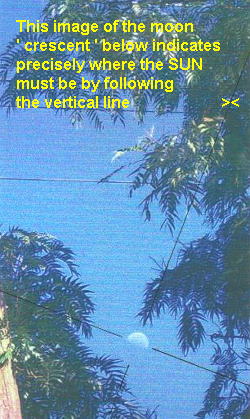 |
Like a torch shining on a ball, we look at the moon during
the day and see the 'crescent' where the un-lit and sun lit
area of the moon meet. Geometry allows to project an
imaginary centre line from the crescent that should lead directly to the Sun, -
|
It is hoped someone will be able to offer an explanation to this
curious phenomenon. (Naively referred to as my
' bent axis theory ' )
The Sun shines directly onto the planets, the Earth and our Moon. From
earth we can observe both moon and sun in the same sky, but usually at opposite
points of the compass.
These images were taken at 12.40 pm 22 March 2006 in Melbourne Australia.
I have noticed the same misalignments during other times of the year.
I am sure the same phenomena occurs where ever the moon and the sun
appear in the same sky all over the world. I suspect the only differences
maybe which side of the centre line the sun will be?
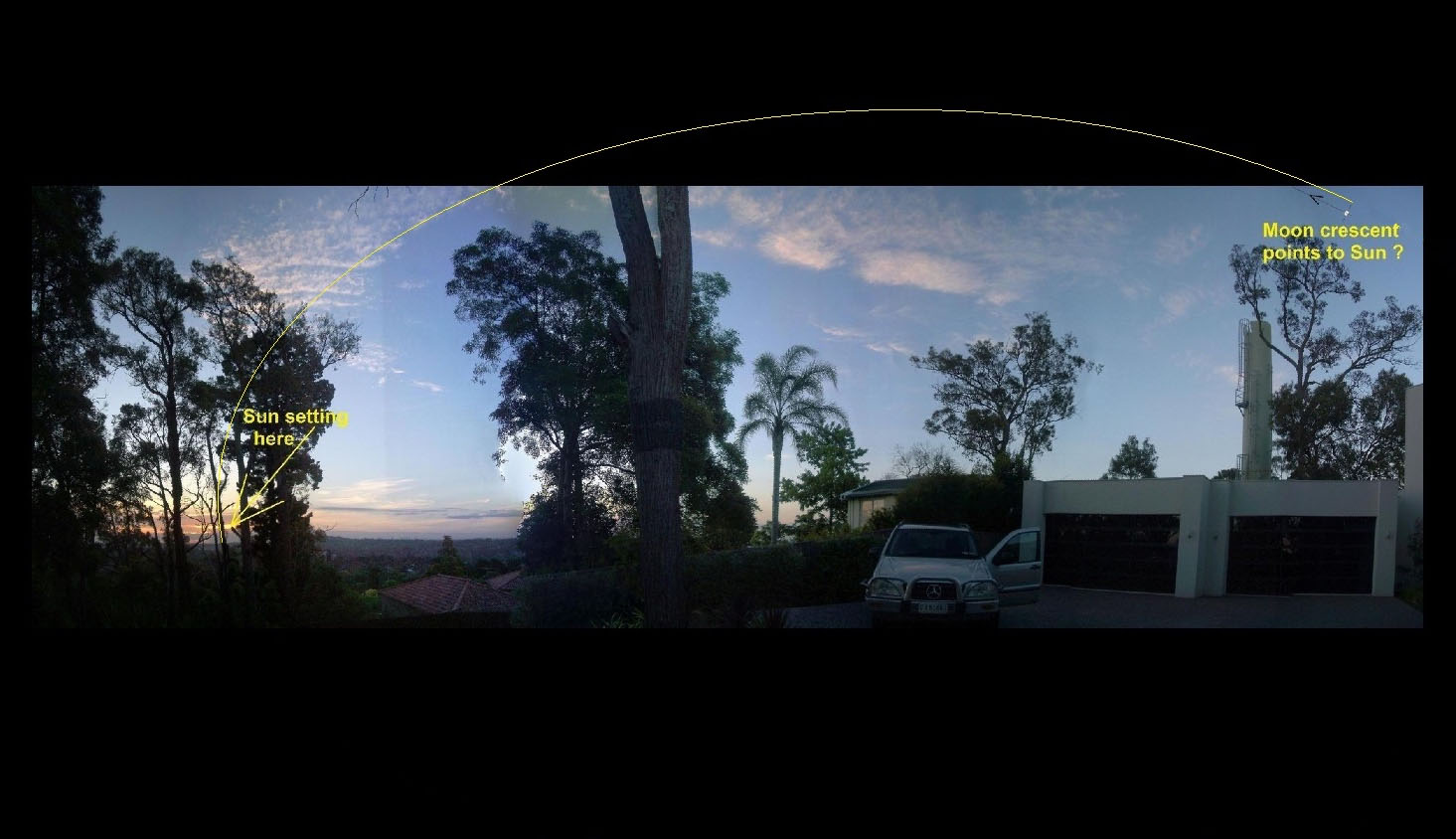
Using a fish eye lens effect shows both the moon and the sun on
the one image taking in approximately 140 degrees of sky. The moon was
in front of me and the sun to my back while overhead -but slightly to my
right. Later in the year when the sun is a lot lower, the same miss
alignment occurs.
The camera was set on a tripod to follow the sky arc. Some eight
standard digital camera images were
stitched together using panorama
Pixmaker stitched to form one image with both the Moon and the Sun scanning 140
degrees of sky on
the one image. There was no manipulation or trick photography. Eight
digital images, each having a portion of overlap with tree foliage to
ensure continuity from one image to the next. In our case the
complete image was printed on * paper that allowed me to draw on the
projection lines. ( *reason for low quality images )
You will notice the projected moon line does not meet up with the
sun.
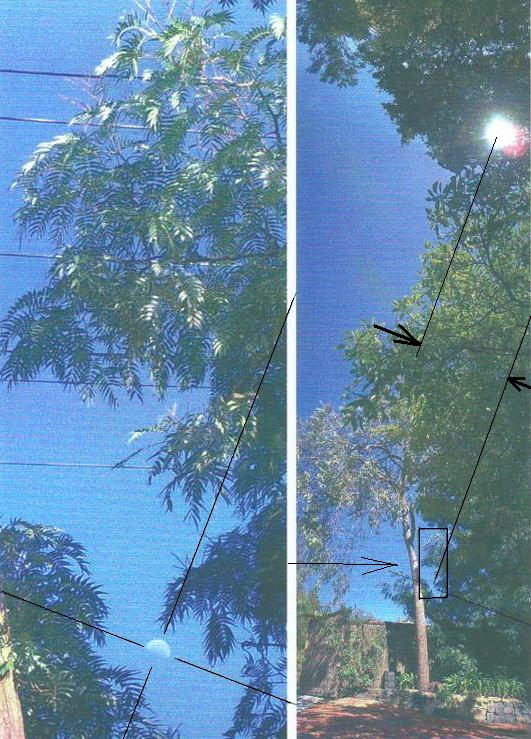
The image (above right) shows a brick driveway and a tall brush fence
looking South West.
Through the tree foliage the moon was photographed first and then in
succession - the next seven images to include the Sun 'back overhead' in
the North East sky. You will
notice the trees at each end of the picture are pointing in towards
each other. That's because the image should be viewed as from inside a
hemisphere.
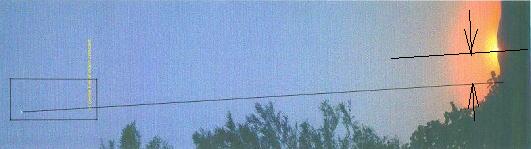
One close up 'moon image' in 'high resolution' (left ) and that
portion rectangle can be seen in the full ARC picture on
the right. Please accept the line angles are hand drawn and indication what seems to be happening. The sun is
shining through foliage in order to protect the camera, but the hot
spot indicates exactly the Sun's true position is,- in reference to the moon centre line.
What ever the scientific name or explanation for
this apparent miss alignment,
I can only consider that sunlight is actually bending.
It would be most interesting to ask if this phenomenon also occurs in
outer space?
An astronaut looking out from his spacecraft may see a truer alignment
(more as we would expect by light coming from
a hand torch lighting a small ball?
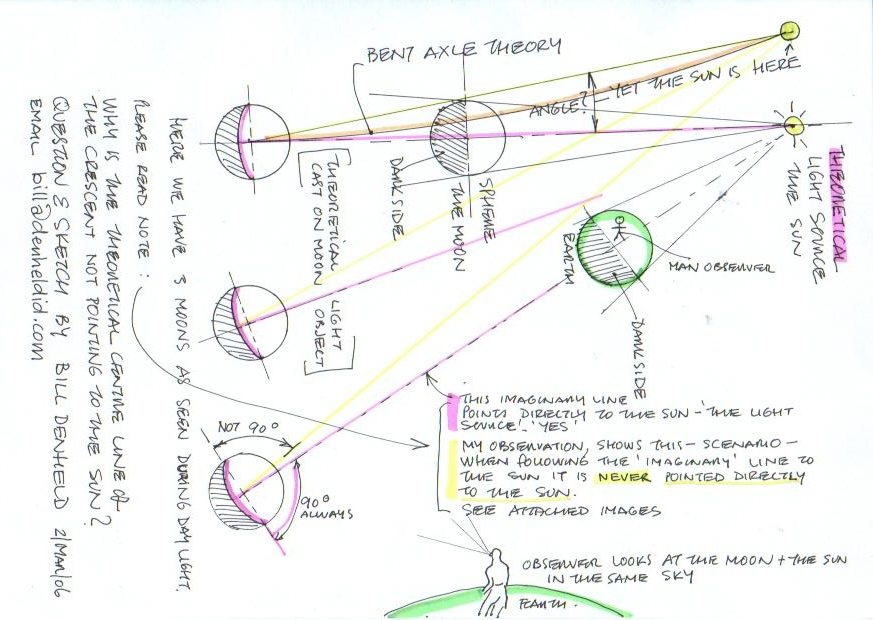
Below is my rough sketch showing the Sun projecting light reaching the
earth and the moon. It is curious to note this
theoretical alignment
does not actually take place for us to see?
The observable Sun in our sky seems to be about 10 degrees off
it's true position if the moon crescent is any indication.
My technical illustration teacher always said,- draw what you know, not what you see .
I think he was right with this statement.
Take for instance, a ball in a box. If a drawn perspective of the box is
correct, a sphere will fit inside the box touching at
only six points at the exact centre of each of six square box
sides.
A sphere in perspective is still seen as a circle, but a circular disc
in perspective is seen as
an 'ellipse' depending on the view angle. An ellipse has a minor and a
major axis. The minor axis is the axle for a pair of parallel wheels. In our
moon-sun case, the moon crescent represents a wheel with an axle, and at
the other end - the Sun. ( also a wheel on an axis )
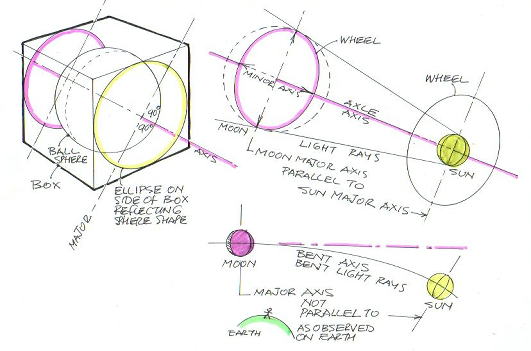
The only difference between our moon / sun example is the distance between the wheels, and the axis
are always straight.
When viewing a 'Moon crescent', the laws of physics and geometry tells us
' just like wheels' at each end of a straight axle, the
wheels must always be parallel to each other. Other wise we
have a bent axis.
In our observed case, if the axis is not bent or curved, then the major
ellipse axis are not parallel to each other?
Is there a bending light axis theory in the universe?
Is this proof that light is
bending ?
This close up crescent is part of the full image below.
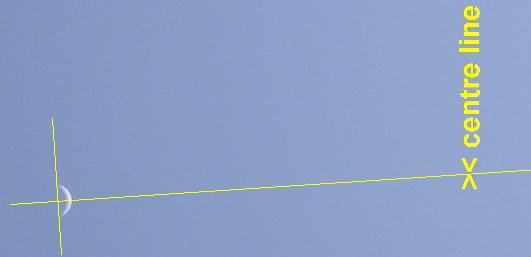
I have plotted the alignment of the Sun's rays to pass between the V's
(above) and striking the moon crescent at the very centre. Assuming
light travels in a straight line, this example shows about a * 4 degree
miss alignment. ( *subject to error )
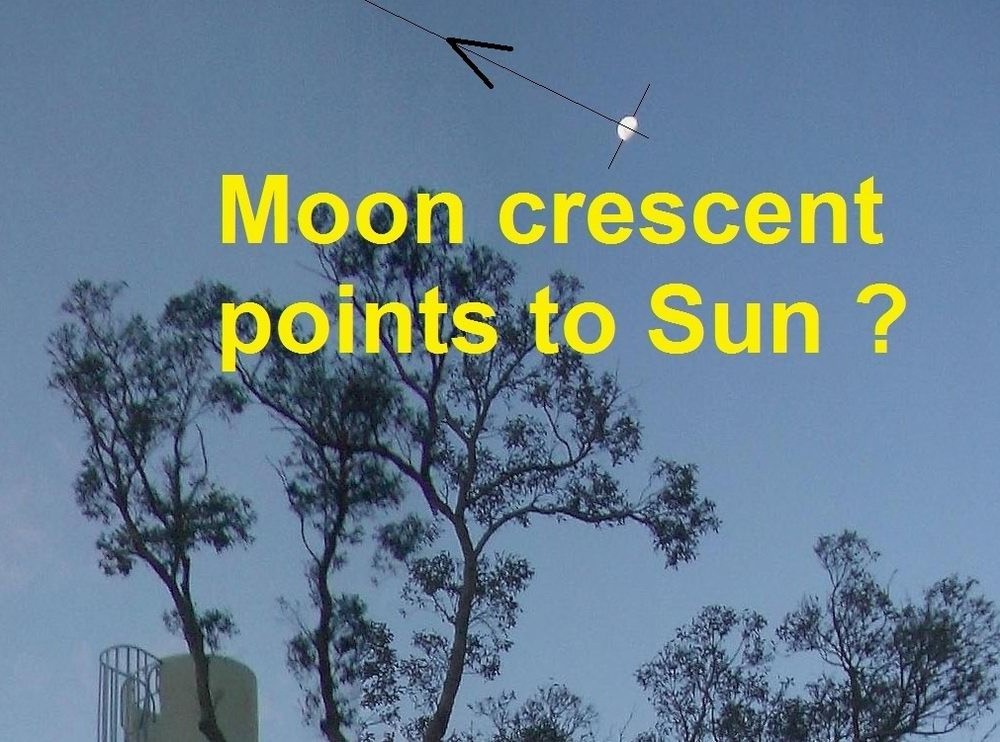
Below: The Moon crescent points to the sun at Croydon Victoria 12
Dec 2013
Below: This image shows Sunset below the horizon yet the Moons
eclipse shows the sun should be up in the sky?
I am sure there will be a simple explanation when we hear from the experts?
Back ground to this webpage.
Early 2nd March 2006, via the internet I made contact with
several astronomy departments in Australia. Clicking on 'Contact Us'
window, I personally asked
for my question to be passed on to relevant Astro experts in the field.
While I received several encouraging replies, it was suggested I should
post my questions on a science forum like Dr Karl on the ABC.
But because forums
like this do not support
pictures, I needed to create this webpage with pictures for people to be able to see what
I was on about.
For want of a better description, I titled it thus-
' Moon and Sun- bent light axis?
Moon crescent
not pointing to the Sun ? '
However, unbeknown to me on 8th March 2006 ( six days after I made
contact) a question similar to
mine was posted on the ' Bad Astronomy and Universe Today
forum ' BAUT -
now
https://forum.cosmoquest.org/forum/science-and-space/astronomy/38249-why-does-the-moon-s-terminator-not-appear-orthogonal-to-the-direction-of-the-sun?39035-Why-does-the-moon-s-terminator-not-appear-orthogonal-to-the-direction-of-the-sun=
The forum thread starter' used a more scientific title than my clumsy one above-
Why
does the moon's terminator not appear orthogonal to the
direction of the sun? was posted by 'Clop' , a BAUT forum member from Adelaide
Uni
Australia.
The timing of this thread posting was six days after my email was sent
to Adelaide Uni and to several astronomy institutions in Australia?
However, thanks to thread starter 'Clop' and BAUT forum, we
can now read how the best minds from the world over views this
misalignment phenomena.
To date there are more than 400 postings.
I'd always be interested to hear what others think.
Bill Denheld
__________________________________________________________________
 Bill Denheld,
is an Industrial designer, model maker, technical
illustrator and company director of Denheld Industrial Design. An
interests in Australian history he is
a
researcher into Ned Kelly story that some believe is an Australian folk
hero, but to others as a murderer criminal. Bill's keen eye has helped solve
several 70 old year mysteries surrounding where the Kelly
gang evolved in North East Victoria. Using the Sun
to orientate early Police 'forensic' photos, Bill concluded the
true site was not the where other historians believed it was, but quite
nearby on the other side of a creek and now identified as the true
sitew where two of the three policemen
were killed by the Kelly gang in October of 1878.
Bill Denheld,
is an Industrial designer, model maker, technical
illustrator and company director of Denheld Industrial Design. An
interests in Australian history he is
a
researcher into Ned Kelly story that some believe is an Australian folk
hero, but to others as a murderer criminal. Bill's keen eye has helped solve
several 70 old year mysteries surrounding where the Kelly
gang evolved in North East Victoria. Using the Sun
to orientate early Police 'forensic' photos, Bill concluded the
true site was not the where other historians believed it was, but quite
nearby on the other side of a creek and now identified as the true
sitew where two of the three policemen
were killed by the Kelly gang in October of 1878.
Australian
history webpage Ned Kelly research
Ned Kelly sites,
www.ironicon.com.au
Bill's old 2000 era work webpage
www.denheldid.com